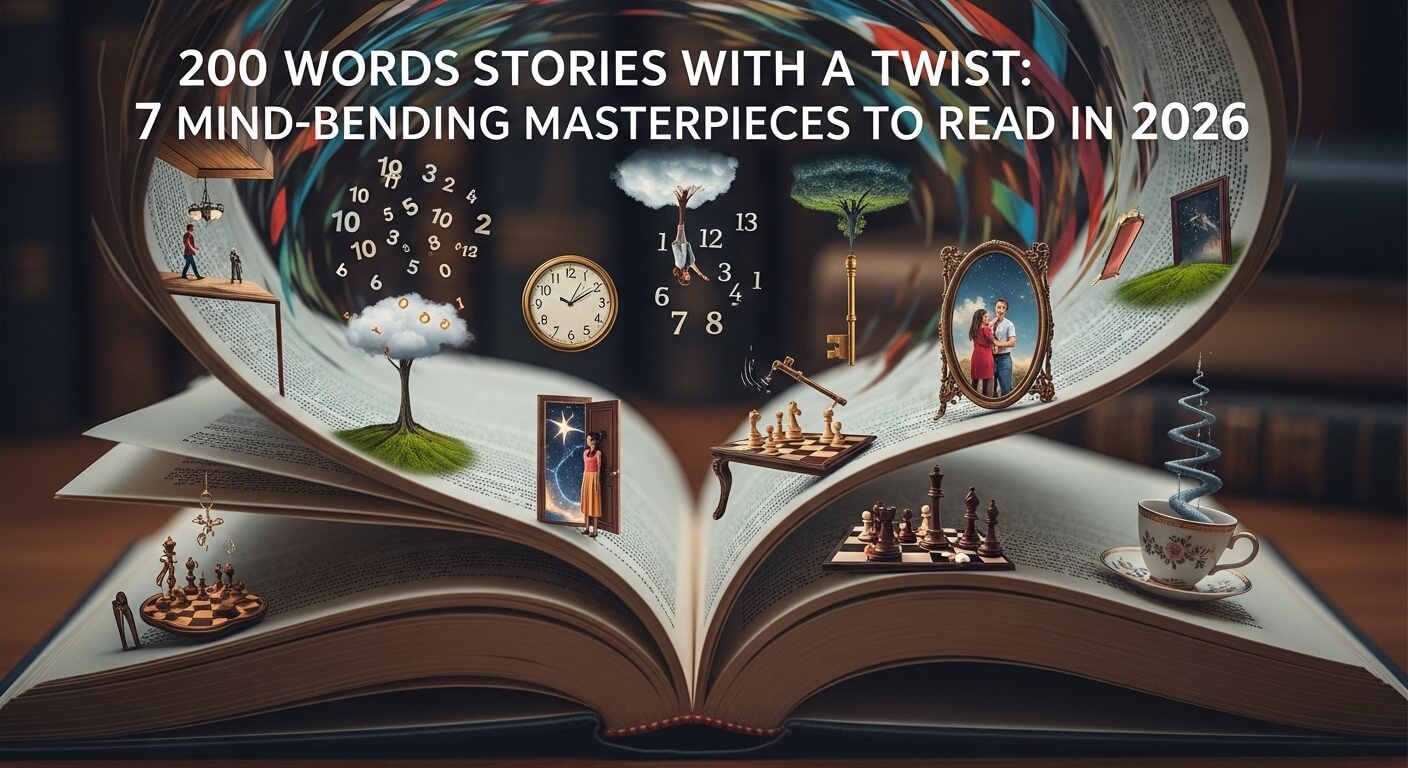
The Evolution of Micro-Fiction in 2026
In the fast-paced digital landscape of 2026, our attention spans have evolved, but our hunger for deep, impactful narratives remains unchanged. This has led to the golden age of flash fiction. Specifically, 200 words stories with a twist have become the ultimate currency in the “bite-sized” entertainment economy. These stories, often referred to as “micro-narratives,” require a surgical precision that few writers master. They must establish a world, develop a character, and subvert the reader’s expectations—all in less time than it takes to drink a cup of coffee.
Whether you are a reader looking for a quick cognitive jolt or a writer looking to master narrative structure, understanding the mechanics of a plot twist in a confined space is essential. Below, we explore seven original stories designed to challenge your perception, followed by a guide on how to craft your own mind-bending micro-fiction.
1. The Memory Uploader
The clinic was pristine, smelling of ozone and sterile promises. Elias sat in the chair, the neural-link humming against his temple. “You’re sure you want to delete her?” the technician asked, his fingers hovering over the ‘Execute’ command. Elias nodded, his heart heavy. “Every memory. The laughter in the kitchen, the way she smelled like rain, the fight we had before the accident. I can’t live with the ghost of her anymore.”
The technician sighed, a sound of practiced empathy. “Processing 500 gigabytes of data. This will take a moment.” As the progress bar filled, Elias felt a strange lightness. The grief began to thin, replaced by a vacuum of calm. When the chime finally rang, he looked around the room, confused. “Where am I?” he asked.
The technician looked at him, his eyes filled with a terrifying pity. “You’re in the Memory Uploader Clinic, sir. But there’s a problem.” Elias frowned. “What problem?” The technician pointed to the screen. “We didn’t delete her memories from your mind. We deleted you from hers. She’s the one who paid for the service, Elias. You’re just the digital backup she left behind to be wiped.”
The Breakdown: Why This Twist Works
This story utilizes plot subversion by shifting the perspective of who is the “real” person in the room. In 2026 storytelling, we often play with the blurring lines between digital consciousness and reality. The twist works because it subverts the “protagonist’s agency”—the reader assumes Elias is the one in control, only to find he is the data being discarded.
2. The Last Guardian
The bunker was deep, designed to survive a thousand years of nuclear winter. Captain Sarah Vance stood before the heavy steel doors, her hand trembling on the biometric scanner. Outside, the world was a silent, frozen tomb. Inside, the last of humanity slept in cryo-stasis, waiting for the sensors to detect green grass and breathable air. “Status report,” she whispered to the AI.
“Atmosphere: Toxic. Radiation: Lethal. Estimated recovery time: 400 years,” the AI replied. Sarah sighed, checking her own oxygen tank. She was the Guardian, the one who stayed awake to ensure the life-support systems never failed. It was a lonely life, but a necessary one. She looked at the thousands of pods, each holding a dream of the future.
She pressed a button, and her own pod hissed open. As she climbed inside, she checked the log one last time. She saw a notification she hadn’t noticed before. “Unit 01: Occupancy detected.” She frowned. She was Unit 01. But the log said she had been inside for 400 years already. She looked at her hands—they weren’t skin, but polished chrome. She wasn’t the Guardian waiting for humanity; she was the machine humanity had left behind to pretend it was still alive.
3. The Inheritance
Julian stood at the edge of the cliff, clutching the tattered envelope. His father’s will was specific: “Go to the place where I lost everything, and you will find your fortune.” Julian had spent years resenting the old man’s cryptic nature. He expected a map to a hidden cache or a bank account number. Instead, the envelope contained only a small, rusted key and a single GPS coordinate.
He looked down at the crashing waves. This was where his father’s business empire had collapsed forty years ago. Julian saw a small, weathered box wedged in a crevice of the rock. He climbed down, his breath hitching as he inserted the key. It turned with a satisfying click. He threw the lid open, expecting gold, or perhaps diamonds.
The box was empty, save for a mirror at the bottom. Taped to the glass was a note: “The fortune isn’t what’s inside, Julian. I lost everything because I forgot to look at who I was becoming. You’re still standing on the cliff. Don’t jump for the money like I did.” Julian looked up, hearing sirens. He realized then that the “fortune” wasn’t the box—it was the police arriving to arrest him for the embezzlement he’d committed to get here.
Mastering the Art of the 200-Word Narrative
Writing 200 words stories with a twist requires a mastery of minimalist prose. To succeed in this format, writers must focus on three core pillars:
- The Economy of Language: Every word must serve two purposes. A description of a room should also hint at the character’s emotional state. In 2026, readers appreciate lean narrative styles that get straight to the conflict.
- The False Premise: You must lead the reader down a path they think they recognize. Use common tropes (the loyal robot, the grieving lover, the detective) to build a foundation of “knowns” before pulling the rug out.
- The Cognitive Leap: The twist shouldn’t be explained. The reader should be able to connect the dots in the final sentence. If you have to explain the twist, the story has failed.
4. The Perfect Match
The algorithm was never wrong. In the year 2026, “SoulSync” had a 99.9% success rate in pairing life partners. Mark sat in the bistro, nervously smoothing his tie. The app signaled that his match was within ten feet. His heart thudded. Would she be everything the data promised? The door opened, and a woman walked in, glowing with the exact shade of amber light he found most attractive.
They spoke for hours. It was effortless. They liked the same obscure 20th-century jazz, preferred the same level of spice in their food, and shared a weird obsession with antique clocks. “It’s like we’re the same person,” Mark laughed, reaching across the table to touch her hand. She smiled, her eyes reflecting his own excitement. “The algorithm is incredible,” she agreed.
As the night ended, Mark walked her to her car. “I have to confess,” he said. “I was worried this wouldn’t work.” She tilted her head. “Why?” Mark looked at his phone. “Because my phone died an hour before we met. I just walked into the bistro and sat with the first person I saw.” The woman’s smile didn’t waver. “Oh, Mark,” she whispered, “I don’t have a phone. I’m the beta-test for the new SoulSync Android. I was programmed to be whoever sat at that table.”
How to Use LSI Keywords for Better Reach
When creating content around short-form fiction, it’s important to integrate LSI (Latent Semantic Indexing) keywords naturally. This helps search engines understand the context of your writing beyond just the primary keyword. In 2026, search algorithms favor content that demonstrates literary depth and authoritative storytelling. Consider using terms like:
- Narrative Arc
- Character Archetypes
- Sudden Fiction
- Speculative Fiction
- Subverting Expectations
- Prose Economy
5. The Silent Witness
Detective Miller looked at the crime scene. The room was sealed from the inside. No weapon, no signs of struggle, just a man dead at his desk. The only other living thing was a parrot in a gilded cage. “Did you see it, Polly?” Miller joked, scribbling in his notepad. The parrot remained silent, its black eyes tracking Miller’s every move.
The forensic team found nothing. No poison in the coffee, no hidden needles. Miller returned the next day, obsessed. He sat at the desk, trying to see what the victim saw. He noticed a small smudge on the window. Outside, a tree branch scraped against the glass. Scritch. Scritch. The parrot suddenly ruffled its feathers and squawked. “It’s in the walls! It’s in the walls!”
Miller laughed. “Old houses, Polly. Just the wind.” He leaned back, his head hitting the tall leather chair. Suddenly, he felt a sharp sting in his neck. He tried to move, but his muscles turned to lead. The parrot watched him slump over. Then, the bird reached out with a claw, unlatched its own cage, and spoke in a perfectly human voice: “That’s two detectives this week. We’re going to need a bigger cage for the next one.”
FAQs: Understanding Micro-Fiction with a Twist
What is the most important element of a 200-word story?
The most critical element is the conflict-to-resolution ratio. You have very little space, so the conflict must be established within the first two sentences to allow enough room for a meaningful twist.
Can a 200-word story actually have character development?
Yes, but it must be implied. Instead of describing a character’s history, show their character through a single, high-stakes decision they make in the moment.
How do I make a twist feel earned and not cheap?
Ensure that if the reader goes back and reads the story a second time, the clues for the twist were hidden in plain sight. A “cheap” twist comes out of nowhere; an “earned” twist was inevitable but overlooked.
Is flash fiction a viable career in 2026?
Absolutely. With the rise of subscription-based newsletters and micro-fiction apps, writers are monetizing “Daily Twist” stories for audiences who want quick, high-quality entertainment during commutes.
What is the difference between flash fiction and micro-fiction?
While the terms are often used interchangeably, flash fiction usually covers stories up to 1,000 words, whereas micro-fiction—like the 200-word stories here—is much more restrictive and focused.
Conclusion: The Power of the Short Narrative
As we navigate the information-heavy world of 2026, the ability to tell a profound story in a limited space is a superpower. 200 words stories with a twist are more than just clever tricks; they are a testament to the efficiency of human language and the enduring power of surprise. By mastering the setup and payoff, writers can create emotional resonance that lingers long after the reader has scrolled past. Keep practicing, keep cutting unnecessary words, and remember: the best stories aren’t the ones that tell everything, but the ones that leave the reader questioning what they thought they knew.