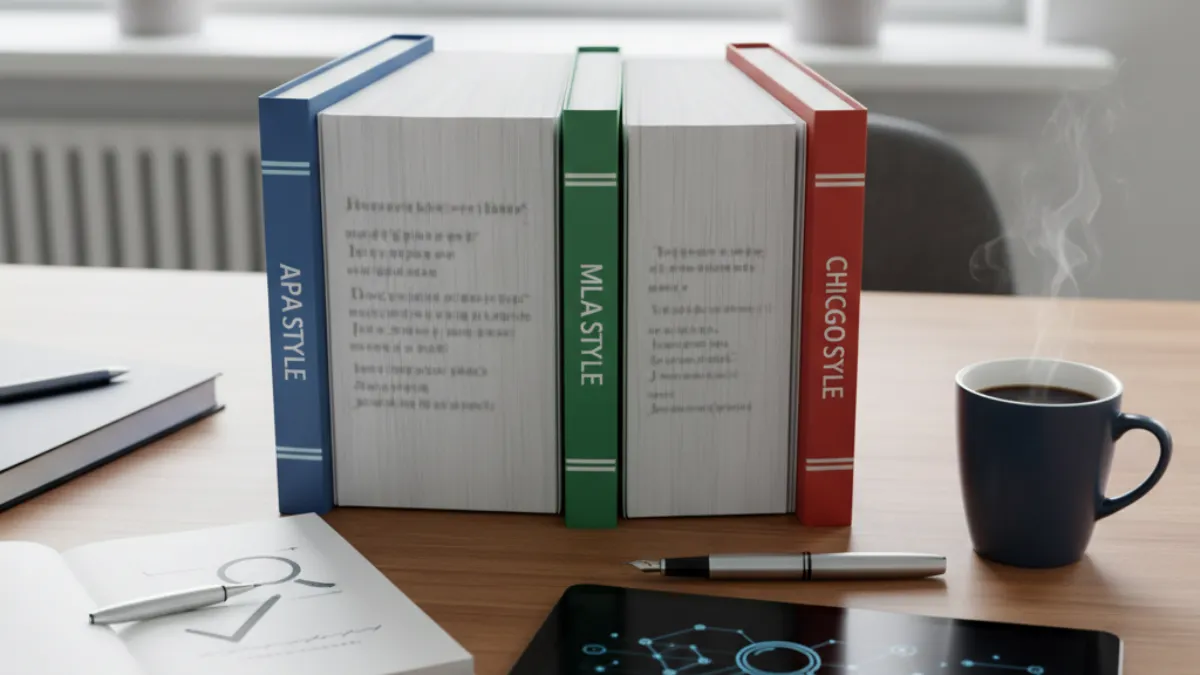
- Consistency is King: Regardless of the style (APA, MLA, or Chicago), the most important rule is to remain consistent throughout your entire document.
- Core Components: Every book citation generally requires the author’s name, book title, publication year, and publisher.
- Medium Matters: Citation formats differ slightly between physical print books, e-books, and books accessed through online databases or AI research assistants.
- Digital Identifiers: In 2026, including a DOI (Digital Object Identifier) or a stable URL is increasingly mandatory for all digital formats.
Table of Contents
- Why Proper Citation is Essential in 2026
- The Core Elements of a Book Citation
- Citing a Book in APA Style (7th Edition)
- Citing a Book in MLA Style (9th Edition)
- Citing a Book in Chicago Manual of Style
- Special Cases: Edited, Translated, and Multi-Volume Books
- How to Cite E-Books and Online Editions
- Citing Books Summarized by AI Tools
- Frequently Asked Questions
- Conclusion: Mastering the Art of Referencing
Why Proper Citation is Essential in 2026
Understanding how do you properly cite a book is more than just an academic formality; it is the cornerstone of intellectual honesty and information traceability. In an era where AI-generated content and rapid information sharing are the norms, providing a clear map back to your original sources is vital for establishing E-E-A-T (Experience, Expertise, Authoritativeness, and Trustworthiness).
Properly citing a book serves three primary purposes: it gives credit to the original author, it allows your readers to verify your facts, and it protects you from accusations of plagiarism. Whether you are a student, a researcher, or a professional content creator, mastering these styles ensures your work stands up to rigorous scrutiny.
The Core Elements of a Book Citation
Before diving into the specific nuances of different style guides, it is helpful to understand the basic building blocks of any book citation. When you pick up a book to use as a source, ensure you record the following information:
- Author(s) or Editor(s): Who wrote or compiled the book?
- Title and Subtitle: What is the full name of the work? (Usually found on the title page, not just the cover).
- Publication Year: When was this specific edition published?
- Publisher: Which company produced the book?
- Edition: Is it the 2nd edition, a revised edition, or the original?
- Location (Chicago Style only): Historically, the city of publication was required, though this is being phased out in many modern styles.
- DOI or URL: For digital versions, where can the book be found online?
Citing a Book in APA Style (7th Edition)
APA (American Psychological Association) style is predominantly used in the social sciences, education, and business. It emphasizes the “when” of the research, which is why the date is placed prominently near the beginning of the citation.
APA Reference List Format
The general structure for a whole authored book in APA is:
Author, A. A. (Year). Title of book (Edition). Publisher. DOI/URL
Example: Print Book
Miller, J. R. (2024). The future of digital ethics. Academic Press.
APA In-Text Citations
APA uses the author-date system for in-text citations. If you are quoting directly, you must also include the page number.
- Parenthetical: (Miller, 2024, p. 142)
- Narrative: Miller (2024) argued that digital ethics are evolving rapidly (p. 142).
Citing a Book in MLA Style (9th Edition)
MLA (Modern Language Association) style is the standard for humanities, literature, and cultural studies. It focuses on the “containers” of information, making it flexible for various media types.
MLA Works Cited Format
The general structure for a book in MLA is:
Author Last Name, First Name. Title of Book. Edition (if any), Publisher, Year.
Example: Print Book
Tan, Amy. The Joy Luck Club. 2nd ed., Penguin Books, 2021.
MLA In-Text Citations
MLA uses the author-page system. Unlike APA, no comma is used between the author’s name and the page number, and the year is not included in the text.
- Parenthetical: (Tan 78)
- Narrative: Tan explores the complexity of mother-daughter relationships (78).
Citing a Book in Chicago Manual of Style
The Chicago Manual of Style (CMOS) is often used in history, business, and the arts. It offers two systems: Notes and Bibliography (common in humanities) and Author-Date (similar to APA, common in sciences).
Chicago (Notes and Bibliography) Format
In this system, you use footnotes or endnotes and a bibliography at the end.
Bibliography Entry:
Last Name, First Name. Title of Book. City of Publication: Publisher, Year.
Footnote:
1. First Name Last Name, Title of Book (City: Publisher, Year), Page Number.
Example:
Bibliography: McCullough, David. John Adams. New York: Simon & Schuster, 2001.
Footnote: 1. David McCullough, John Adams (New York: Simon & Schuster, 2001), 345.
Special Cases: Edited, Translated, and Multi-Volume Books
Rarely is every book written by a single author. You will often encounter edited collections or translated works that require additional information.
Edited Books (No Author)
If a book is a collection of essays by different authors, cite the editor in the author position.
- APA: Smith, J. D. (Ed.). (2025). Modern linguistics. Wiley.
- MLA: Smith, John D., editor. Modern Linguistics. Wiley, 2025.
Translated Books
It is crucial to credit the translator to maintain the integrity of the source’s voice across languages.
- APA: Murakami, H. (2023). The city and its uncertain walls (P. Gabriel, Trans.). Knopf. (Original work published 2023).
- MLA: Murakami, Haruki. The City and Its Uncertain Walls. Translated by Philip Gabriel, Knopf, 2023.
How to Cite E-Books and Online Editions
As we progress through 2026, the distinction between a “book” and an “e-book” is almost nonexistent in terms of importance, but the citation must still reflect the format used. If you accessed the book on a Kindle, an e-reader, or through a library database, you should include this information.
APA E-Book Citation
Include the DOI if available. If no DOI is available, use the URL of the site where the book was purchased or accessed. You no longer need to mention the device (e.g., Kindle edition) unless it is necessary for identifying the version.
Example: Davis, L. (2025). Climate psychology. Oxford University Press. https://doi.org/10.1017/9781108
MLA E-Book Citation
In MLA, you treat the e-book as a “version” or the website as a “container.”
Example: Davis, Laura. Climate Psychology. E-book ed., Oxford UP, 2025. ProQuest Ebook Central, https://site.proquest.com/lib/univ/detail.action?docID=12345.
Citing Books Summarized by AI Tools
In 2026, many researchers use AI language models to summarize long texts or locate specific information within books. If you are citing a summary generated by an AI rather than the book itself, you must be transparent about this.
Crucial Rule: Always try to find the original passage in the physical or digital book. If you cannot, and must cite the AI’s interpretation, use the following logic (based on emerging 2026 guidelines):
- APA: OpenAI. (2026). ChatGPT response regarding summary of ‘The Republic’ by Plato [Large language model]. https://chat.openai.com/
- MLA: “Summary of The Republic by Plato.” ChatGPT, 14 Jan. 2026, OpenAI, https://chat.openai.com.
Frequently Asked Questions
1. Do I need to include the city of publication?
In APA 7th Edition and MLA 9th Edition, the city of publication is no longer required. However, the Chicago Manual of Style still prefers it in the Notes and Bibliography system. Always check your specific department’s requirements.
2. How do I cite a book with more than three authors?
In APA, you list up to 20 authors in the reference list. In the in-text citation, use the first author followed by “et al.” (e.g., Smith et al., 2024). In MLA, use the first author followed by “et al.” in both the Works Cited and the in-text citation (e.g., Smith et al. 45).
3. What do I do if the book has no publication date?
Use the abbreviation “n.d.” for “no date.” In APA: (n.d.). In MLA: n.d. However, in 2026, most digital records will have a copyright or “last updated” date that you should use if possible.
4. How do I cite a chapter in an edited book?
This is common in textbooks or essay collections. You cite the author of the chapter first, then the title of the chapter, then the editor and the title of the whole book.
Example (APA): Author, A. A. (2024). Chapter title. In B. B. Editor (Ed.), Book title (pp. 100-120). Publisher.
5. Can I use an online citation generator?
Yes, tools like Zotero, Mendeley, and Cite This For Me are excellent, especially with 2026 AI-enhanced scanning. However, always manually verify the output against the official style guide, as software often makes mistakes with capitalization and italics.
Conclusion: Mastering the Art of Referencing
Learning how do you properly cite a book is a foundational skill that elevates your writing from a simple collection of thoughts to a scholarly contribution. By choosing the correct style—APA for the sciences, MLA for the humanities, or Chicago for history—you provide your audience with the transparency and professionalism they expect in 2026.
Remember that citation styles are not just “rules to follow” but are designed to help readers find information. When in doubt, provide more information rather than less. As the landscape of information continues to shift toward digital-first and AI-augmented research, staying updated with these standards will ensure your work remains credible and impactful.
Ready to perfect your paper? Double-check your citations with the latest 2026 updates from the Purdue OWL or your university’s library portal to ensure 100% accuracy.