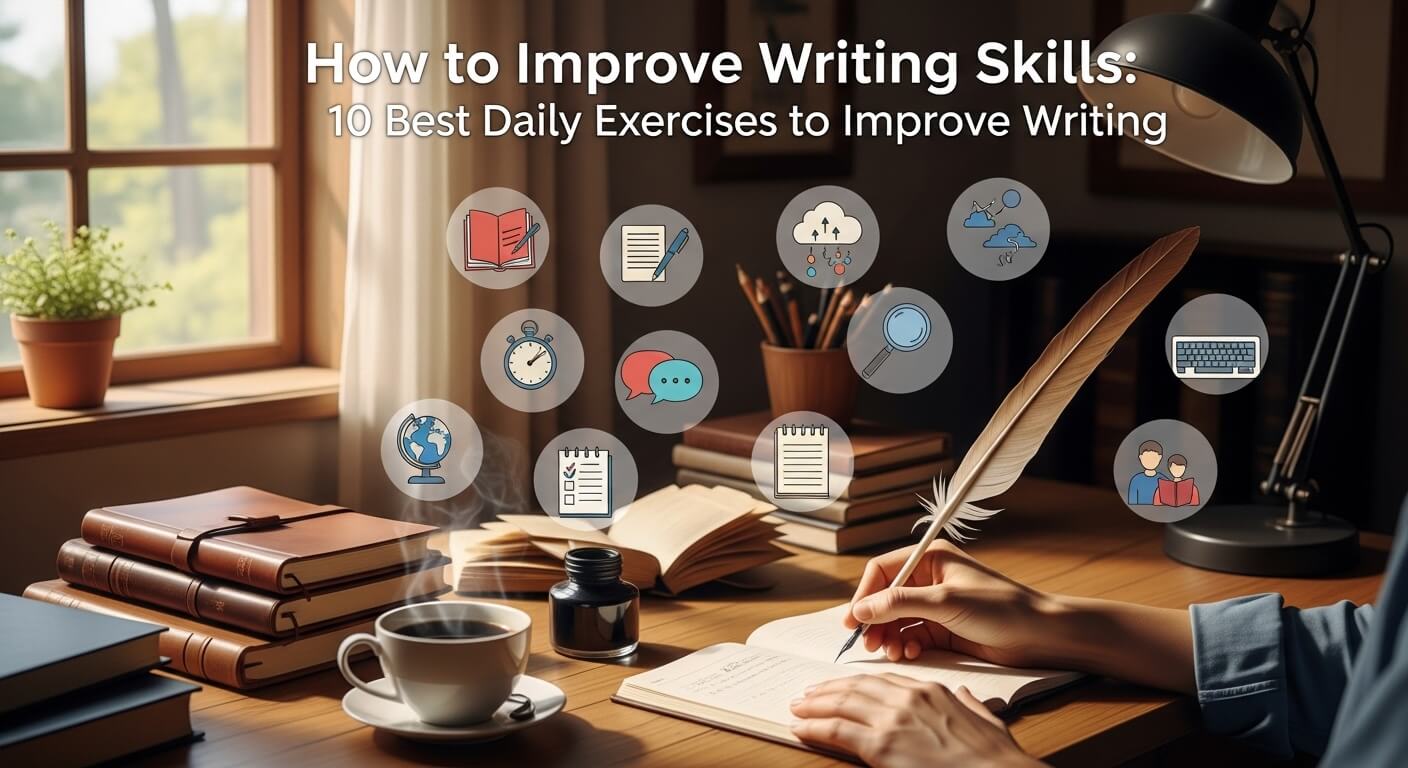
Writing is a skill that develops with consistent practice. Some days you feel like writing is very interesting and you keep on writing about a topic, but on other days it seems a gruelling task.
Hemingway, a great novelist, said: “There are no rules to be followed when you write a good piece of writing”. Sometimes things come easily, sometimes it’s more about breaking through layers, just as digging up rocks.
There is no magic to successful writing. All it needs is hard work and practice to improve writing skills. Whether you are a beginner at writing or a professional writer, there is always room for improvement.
In this article, we will be listing down 10 great exercises for writers that help in producing better written content.
10 Daily Exercises to Improve Writing Skills
The following are useful exercises writers can do to improve their writing skills.
1-Journalling
Journaling is a daily writing habit. Like keeping diaries wherein we write our daily reflections, impressions about people & things around us.
Reflecting upon your feelings can help you become more aware of yourself, as well as improve your mental health significantly. Articulate your thoughts in a journal that makes you nervous or excited.
It is the best way to cope with anxiety and stress issues. This method can also be used to improve writing skills. As you get a blank piece of paper and put down all the thoughts using new words to write details of the day. You can write down digitally using Google Docs or on paper in a private diary.
2-Writing Prompts
By writing prompt, we mean a word, phrase or action that inspires you to write about. That sparks your inspiration. Automatically, you like to write about the topic.
Any topic like love, black magic, black holes, or artificial intelligence that excites you. Start writing about it. Writing prompts are best for getting into the habit of daily writing.
A few common writing prompts you can get started with are
- A childhood memory
- Take an object, write a story about it
- An embarrassing moment in school/workplace/cafe
- Favorite Song
- Favorite Book
You can write about fiction content, but make it short so you don’t get frustrated. Also, if non-fiction is more interesting to you, then write about new information/inventions. Anything that creates an interest in putting down words on paper.
3-Playing Words Games
Human beings are always excited about playing games. Solving a challenge makes people happy, as they have achieved something big. Playing word games is useful for writers in improving their writing skills.
Word Games exposes new words and ideas about topics that they may not have known before. There are many word games, such as strands, connections, scrabble and Wordle to play daily.
But we recommend the strands game as the best for daily playing. In Strands, players search for words related to the theme. Writers learn about a new topic and related words each day.
These terms & concepts can be helpful to them while they write later on for personal or professional use.
4-Reading
Writing can be improved by reading well. Literature helps us understand how various people express themselves and share opinions with others.
How is language used when describing an idea? It is a cumbersome task to read a whole book. It takes several weeks to finish reading one entirely.
Instead, start reading published articles on websites. These articles and blogs are concise and packed with information. You can find tons of articles on any topic related to writing, technology, health, etc.
Writing daily is a great habit for improving writing, but if you are not in the mood for writing. At least, read about a topic you are planning to write about.
Follow specific authors whose writing style you like. Read all their published articles. Follow writers on platforms like Medium, LinkedIn, Vocal Media, etc.
5- The 5 Senses Description Challenge
It is a great exercise to write descriptive and engaging writing. In this writing, use all five senses of sight, sound, smell, touch and taste to explain the scenario. This writing makes readers feel as if they are experiencing the situation first hand.
Example: A person describing a calm, peaceful beach experience during sunset
The sun was low in the sky as I walked on a quiet beach. The warm sunlight touched my skin, and I could hear the gentle waves hitting the shore.
It smelled sweet and salty, yet felt cool, which helped soothe my nerves. It was very comfortable walking on the sand, as there was a lot of fine powder. To sip some water to taste the ocean waters. It was full of salt.
6-Character Interview
Write about a character to improve writing skills. The method expands the writer’s creativity for creating a nice story around a character.
In this exercise, create a list of 20 to 30 questions as if you were a character. Then answer these questions. This exercise helps writers to understand character psyche.
Example: A tea-selling boy character
Questions to include
- Character name and profession
- What does he like about work
- What challenges does he face
- What is his biggest dream
- What kind of person is he
Writing about character
Young Ayaan sells tea from his tiny shop close to the railway junction. He is a hardworking guy who gets out of bed energised. He enjoys his work and likes chatting with clients about things, too.
He has a friendly approach to please his clients. Making tea is an easy task, but he takes pride in his job. Aayan dreams of opening up her café someday.
7-Dialogue Writing
Dialogue writing is the conversation between two people. This exercise is great for plotting characters’ conversations in a story. It shows what to say next and how to keep the conversation flowing.
Example:
Ali asked: “Where are you going?”
Sara replied: “ I am going to the market”
The writing of dialogues helps authors to understand human communication, as it is used when speaking face-to-face with other individuals daily.
It’s one of those ways that can lead you to some good conversations with other folks, too. Dialogue is an effective means to describe characters’ personalities as well as their feelings accurately.
8- Retelling a Story
In this exercise, the writer rewrites a story in his own words. For example, writing a story about a recently watched movie or TV show. Write a review about it.
A lot of films or series are created from novel characters, settings and dialogue, like the Harry Potter movie series and the vampire concept.
Watch a film or episode, write it down on paper or on screen. This will reveal interesting details about writing style. This will not only practice writing but also help with expanding memory muscles.
You can practice the exercise with a movie, TV show, comedy show, song, poetry reading or even a game.
9- Free Writing
Free Writing is a technique to write continuously for a given set of time. For 10 to 20 minutes of writing. A writer does not think about grammatical issues, spelling or topic.
He just writes whatever comes to mind. This exercise improves writing skills and generates ideas to overcome writer’s block.
In free writing, you don’t pause or edit; you solely focus on putting the thought on paper. There are different variations in free writing; you take a topic and stick with it. Write about it for 5 to 10 mins. Do journaling, write whatever comes to mind, no topic involved.
10- Analysing your favourite Book
Analysing a book means carefully looking at the story plot and characters. How the story is structured. How ideas are connected. A writer studies how personalities and emotions are conveyed in a story.
During analysis, a writer got new ideas and inspiration for their own writing. Reading a book teaches them what makes the scene powerful, how the story turns at a point. What works and what doesn’t.
In easy words, analysing a book means you observe how good stories are created. Thus, put those techniques in your own writing.
Conclusion
Use these writing exercises in your routine. All these practices definitely leave a positive impact on the writer’s writing skills. Practice these writing exercises one by one so you don’t overwhelm.
Dedicate a fixed time to writing practice. Track your progress. Also, share your work for feedback. Combine exercises to practice more. Regularly, including these exercises will improve your writing ability and help you discover new ideas of creativity.
Writing skills will help you grow professionally and express ideas clearly and effectively.