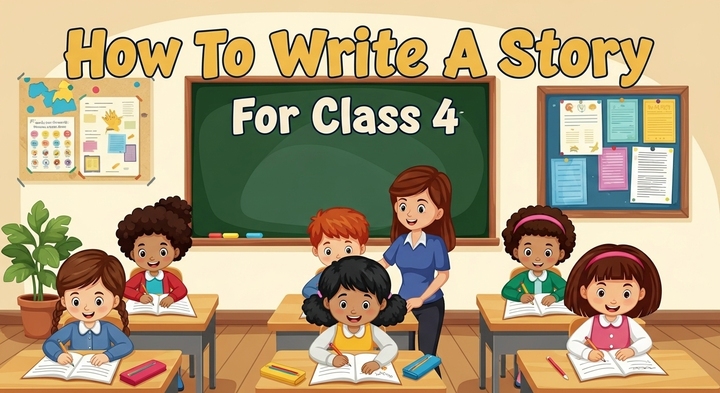
Writing a story in Class 5 is a fun way to share your imagination, thoughts, and experiences. At this level, students are beginning to explore creative thinking in more structured forms, so learning how to write a story properly is both important and exciting. This article will guide you through the storytelling process with a fresh structure made specifically for fifth-grade learners—engaging, easy to follow, and designed to help your story shine.
Discovering the Heart of Your Story
Before writing anything, ask yourself: What do I want to tell?
Every story has a heart—a message, theme, or feeling it leaves the reader with. Whether you want to teach a lesson, entertain with a fantasy, or share a school-day adventure, your story should have a core idea. This “heart” will keep your writing focused.
Tips to find your story’s heart:
- Think of something that made you feel proud, scared, or curious.
- Ask, “What if?” (What if I found a talking dog? What if I got stuck on a spaceship?)
- Consider what you love—animals, magic, superheroes—and create something around it.
Building Blocks: Characters, Setting, and Problem
Once your idea is clear, you need to create the three main ingredients of a story:
Characters
These are the people or animals in your story. Choose a main character (called the protagonist) who the story will focus on.
Example: Lily, a brave girl who dreams of being an astronaut.
Setting
This is where and when your story takes place. Make it vivid so readers can picture it.
Example: A dusty desert village where people say stars fall every night.
Problem (Conflict)
This is what makes the story exciting. The character should face a problem they need to solve.
Example: Lily must stop a falling star from crashing into her village.
Mapping Your Story: Beginning, Middle, and End
To keep your story clear and easy to follow, use this simple story map:
-
The Beginning (Introduction)
- Introduce your main character.
- Show where the story is happening.
- Present the main problem or goal.
Example Start:
Lily looked up at the sky, her heart full of wonder. She had read stories of falling stars all her life. But no one believed they were real—until tonight.
-
The Middle (Rising Action and Climax)
- Add interesting events that build excitement.
- Make the problem more challenging.
- Include a climax (the most exciting part).
Example Middle:
Lily packed her telescope and ran up the hill. A glowing trail burned through the sky. As it got closer, her legs shook—but she didn’t stop. She had to save her village.
-
The End (Conclusion)
- Solve the problem.
- Show how the character has changed or learned something.
- Finish with a strong last sentence.
Example End:
The star shimmered softly in her hands. It didn’t crash—it whispered. And as it faded into light, Lily knew her dreams were only just beginning.
Bringing Your Story to Life: Details and Emotions
Stories are more than just what happens—they’re how things feel and how they look. Use description and emotion to make your story real.
Use the Five Senses
Help your readers imagine the world of your story.
Instead of: “It was a scary cave.”
Try: “The cave was cold and damp. Lily’s breath made clouds in the air, and a drop of water echoed with every step.”
Show Feelings
Don’t just tell the emotion—show it through actions.
Instead of: “She was scared.”
Try: “Lily’s hands trembled, and she took a tiny step back, her heart pounding like a drum.”
Dialogue: Let Your Characters Speak
Good stories often include dialogue—what characters say. It brings them to life and helps the reader understand them better.
Tips for writing dialogue:
- Use quotation marks (“ ”).
- Start a new paragraph when a new character speaks.
- Keep it short and natural.
Example:
“Did you see that star?” Lily gasped.
“No way!” said Max. “It almost hit the ground!”
Drafting: First Try Is Not the Final Try
When you’ve finished your story, read it again. You’ll likely find parts you want to fix or improve. That’s a good thing!
Self-Editing Tips for Class 5:
- Does your story have a beginning, middle, and end?
- Did you use interesting words?
- Are there any spelling or punctuation mistakes?
- Do the characters sound real?
Peer Review: Ask for Feedback
Show your story to a classmate, teacher, or parent. Ask:
- Did you like the story?
- Was anything confusing?
- What was your favorite part?
Feedback helps you see your story in a new way.
Proofreading: Polish Your Work
After making changes based on feedback, it’s time to polish. This step is important before you show your work to others or prepare it for publishing.
Proofreading checklist:
- Correct punctuation and capitalization
- Consistent verb tense
- No repeated words
- Paragraphs start in the right place
At this stage, editing and proofreading services can be a helpful support, especially when preparing your story for school magazines, websites, or competitions. These services can help with grammar, structure, and making your story easier to read.
Publishing: Share Your Story With the World
Publishing doesn’t always mean printing a book. There are many creative ways to publish a story in Class 5:
- Class bulletin board: Ask your teacher to put your story up.
- School magazine or newsletter
- Online story-sharing platforms for kids
- Storybook project: Print your story and make your own illustrated book.
If your school or class offers any publishing or illustration support, use it. It feels amazing to see your work presented nicely!
Bonus: Fun Ideas to Inspire Young Writers
If you’re stuck on what to write, here are some cool ideas to spark your imagination:
- A schoolbag that whispers secrets
- A world where animals talk—but only to kind kids
- A mystery in the library
- A time machine that only works during recess
- A lost diary from 100 years ago
Conclusion
Writing a story for Class 5 is a fun and creative way to express your ideas. By choosing a strong topic, building interesting characters, adding a clear beginning, middle, and end, and checking your work through editing and proofreading, you can create a great story. Remember to use your imagination, be original, and enjoy the process of writing and sharing your story.
FAQs
Q1: How long should a story for Class 5 be?
It should be around 150 to 300 words, depending on your teacher’s instructions. Focus more on clear ideas than length.
Q2: Can I write about magic or animals?
Yes! Fantasy, animals, and even silly adventures are perfect for Class 5 stories.
Q3: Do I have to write in paragraphs?
Yes. Each paragraph should cover one idea or part of the story—beginning, middle, or end.
Q4: Is spelling very important?
Yes, but don’t worry if you make a few mistakes. Always check and fix them before final submission.
Q5: What should I do if I’m stuck?
Talk to your teacher, brainstorm with a friend, or start by drawing your characters or the setting.