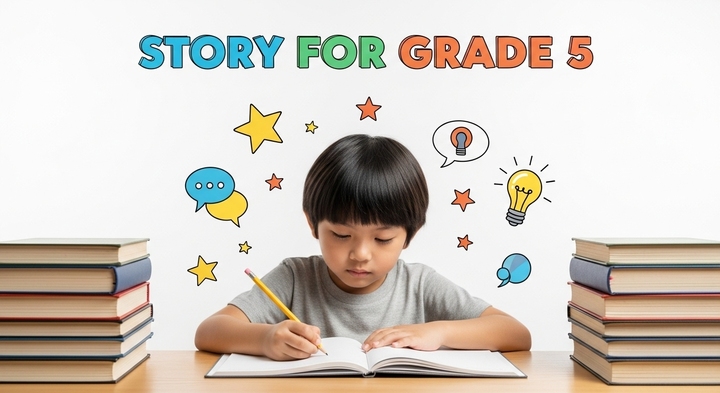
Writing a story in Grade 5 can be a fun and imaginative experience. At this stage, students are starting to understand how to organize their thoughts, use descriptive language, and create stories with engaging plots and characters. Story writing is not just a school task—it’s a wonderful way to express thoughts, feelings, and creativity. This guide will walk you through the entire process of writing a story suitable for Grade 5, including tips on planning, drafting, editing, and even sharing your work with others.
Understanding What a Story Is
A story is a sequence of events that entertains, informs, or teaches a lesson. It usually has a clear structure: beginning, middle, and end. Stories often follow characters through challenges or adventures and conclude with a solution or a message.
There are four main parts of every good story:
- The Beginning: This is where we meet the characters and learn where and when the story is taking place. It sets the stage and hooks the reader.
- The Middle: The most exciting part! This is where something goes wrong, or a challenge appears. The characters must react, learn, or grow.
- The Climax: This is the turning point. Tension is highest, and something big happens that changes everything.
- The End: The conflict is resolved, and the characters return to normal—or a new normal—with something learned or changed.
For Grade 5, the focus should be on clear storytelling, creative ideas, and using language in a fun, descriptive way.
Choosing a Story Topic
Picking the right topic is the first step to an exciting story. Your topic should be something that excites your imagination or connects with your everyday life in a new way.
Here are some helpful tips for choosing a story topic:
- Think About Interests: What do you love to read about? Magic? Pets? Space travel? Sports?
- Remember Experiences: Have you ever gone on a memorable trip? Got lost? Helped someone? These can inspire stories.
- Ask “What If” Questions: What if your school was on Mars? What if your cat could talk? What if you turned invisible?
Topic Ideas for Grade 5
- A treasure map found in the backyard
- A graderoom where the books come to life
- A lonely robot trying to make friends
- A day where everything goes backward
- A school talent show with a big surprise
Encourage bold, unique ideas. No topic is too silly if it has heart and creativity!
Planning Your Story Before Writing
Planning your story helps keep it organized. When you plan, you’re deciding who the story is about, where it happens, and what will take place. This makes the writing part smoother and more enjoyable.
- Characters
Choose 1–3 main characters. Give them names, personalities, and goals. Think about what makes them special or funny. Ask yourself:
- What does the character want?
- What is their biggest fear?
- What makes them different?
Example:
- Tina, a curious girl who wants to become an astronaut
- Buddy, a mischievous talking parrot
- Uncle Vikram, the forgetful inventor
- Setting
The setting is where your story takes place. Be specific. Instead of just saying “in a forest,” describe the trees, animals, and atmosphere.
Examples:
- A floating village in the clouds
- An old railway station during a thunderstorm
- A garden that changes with emotions
- Problem/Conflict
Every good story has a problem. Without it, the story feels flat. Think about what challenge your character faces.
Examples:
- Tina gets lost in space
- Buddy steals something important and won’t give it back
- A magic clock stops time, and no one knows why
- Solution/Ending
The resolution shows how the problem is fixed or what your character learns. Maybe they grow, make a friend, or discover something new.
Creating an Outline (Story Map for Grade 5 Students)
An outline is like a map for your story. It helps you plan the flow and events. Here’s a basic outline you can use:
|
Story Part |
What to Include |
|
Beginning |
Introduce your main characters and setting. |
|
Middle |
Present the problem or adventure. Build up the excitement. |
|
Climax |
The most dramatic part. Something unexpected happens. |
|
Ending |
The problem is solved. Show what the character learned. |
Taking time to outline can help avoid confusion and make your story easier to follow.
Writing the First Draft
Now it’s time to write! Don’t worry about making it perfect the first time. The goal of the first draft is to get all your ideas down.
First Draft Tips
- Start with a hook: something exciting that grabs attention.
Example: “Ravi woke up and discovered he could fly.” - Keep your sentences short and clear.
- Use dialogue to show characters speaking.
“I don’t believe this,” Ravi said, staring at his feet above the ground. - Use transition words like suddenly, then, next, finally to move the story forward.
- Let the story unfold naturally, but stick to your plan as much as possible.
Revising and Editing the Story
Revising means looking at your story again and making it better. Good writers rewrite and improve many times before they’re done.
When Revising, Ask:
- Does the beginning make the reader curious?
- Does the middle build excitement?
- Is there a strong ending?
- Are the characters believable and fun?
Editing Checklist:
- Check for grammar and punctuation mistakes
- Make sure each sentence makes sense
- Replace boring words with stronger ones
- Cut out unnecessary sentences or details
You can even ask a friend or adult to give feedback. They might spot things you missed!
Proofreading for Grade 5 Students
After revising, it’s time to proofread—a final check for small mistakes. This helps polish your story and make it ready for others to read.
How to Proofread:
- Read your story aloud
- Check one sentence at a time
- Look for spelling, punctuation, and grammar errors
- Use tools like a dictionary if needed
- Circle or highlight words you’re unsure of and ask for help
Even professional authors proofread their work. It’s the key to clean, clear writing.
Illustrating and Formatting the Story
Stories become more fun when you add pictures. Illustrating helps you express the story visually.
What You Can Add:
- Drawings of characters and scenes
- A colorful title page with your name and story title
- Page numbers and chapter headings (if needed)
For neatness:
- Write or type the story clearly
- Keep margins straight
- Use good handwriting or a readable font
Neatly formatted stories look professional and show care.
Sharing and Publishing the Story
Now that your story is finished, it’s time to share it! Whether it’s with grademates, family, or a wider audience, sharing builds confidence and shows pride in your work.
Ways to Share:
- Read your story at a school event
- Create a grade storybook with all students’ stories
- Record a video or audio reading
- Bind your story into a booklet with illustrations
- Turn it into a digital version (PDF or slideshow)
About Light Publishing Services:
While not necessary for school projects, simple publishing steps—like formatting, cover design, or creating a digital version—can make the experience feel special. Teachers and parents can help format or print stories so students feel like real authors.
Encouraging Creativity Through Story Writing
Story writing is more than just a school subject—it’s a way to boost creativity, problem-solving, and communication. Support and encouragement can turn a young writer into a lifelong storyteller.
To Encourage Young Writers:
- Offer praise for effort, not just accuracy
- Create a quiet, creative space for writing
- Use fun prompts or storytelling games
- Celebrate finished stories with applause and display
Every child has a story to tell—sometimes they just need help discovering it.
Final Thoughts
Writing a story for Grade 5 should be an exciting and joyful journey. By picking the right topic, creating strong characters, building a clear outline, and carefully editing and proofreading, students can craft stories that are imaginative, thoughtful, and fun to read. Adding illustrations and sharing the final result with others gives young writers a sense of accomplishment. Whether it’s the first story or the hundredth, every story helps children learn, grow, and dream bigger.
Let imagination lead the way—and let every story be the start of something amazing.
FAQs
Q1: What is the best way to start a story in Grade 5?
Start with an exciting sentence or a question to grab the reader’s attention.
Q2: How long should a Grade 5 story be?
A story can be 1 to 2 pages long, depending on the topic and assignment.
Q3: Can I include pictures in my story?
Yes! Illustrations make your story more engaging and fun to read.
Q4: What should I do after writing my story?
Revise, edit, proofread, and then share your story with others.
Q5: Is it okay to write imaginary or fantasy stories?
Absolutely! Imagination is encouraged—be as creative as you want!